
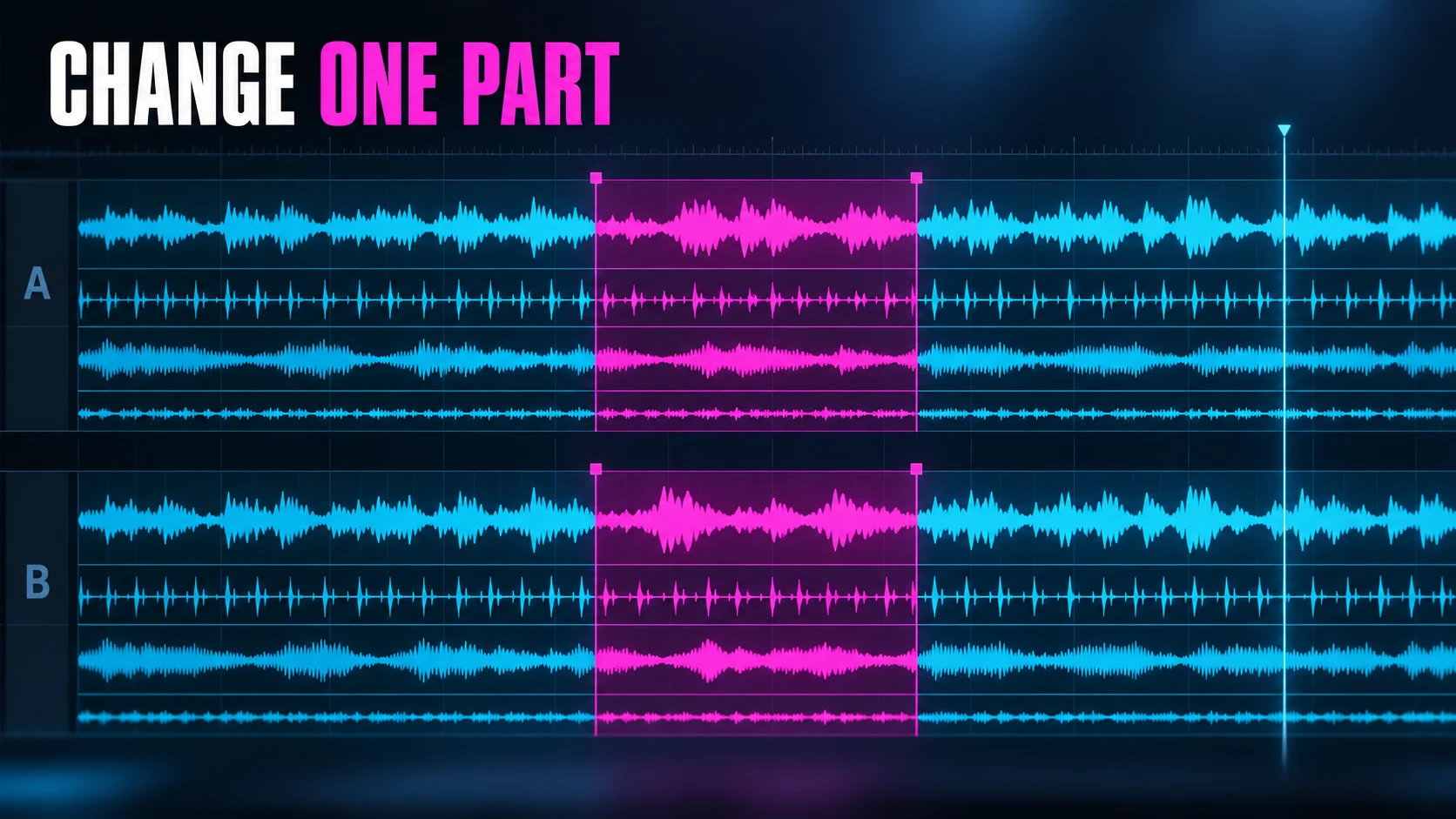
“Keep everything else” is the right instinct and a useless specification. It could mean the words and arrangement survive. It could mean the performance still reads as the same take. It could mean every sample outside the selected region is identical to what you started with. Those are three different standards, and they require three different tests. A localized edit only means something once you name the one the job actually requires.
Take the ordinary case: the verse is signed off, one word in the chorus is wrong. I would guard that verse as hard as I judge the new word. If the replacement is better but the singer now enters a beat late, you did not fix the chorus. You moved the problem.
ACLTracks did not perform a Suno replacement or an audio preservation test for this article. What follows is a proposed listening and export-check protocol built from documented editing features.
What Suno documents
Start with what the vendor actually claims, because that is the ceiling on what you can verify. Suno: Replace Section describes selecting a region, generating alternatives, and creating a Whole Song containing the chosen replacement. Suno: Song Editor also documents adjusting the transition boundary. Suno: Editing tools powered by v6 identifies Replace Section among the editing tools powered by v6.
Suno: Take lanes in Studio describes retaining the original audio when using replacement and auditioning alternatives before promotion. That is good recovery behavior inside the editor, and it is worth having. It is not, by itself, evidence that a later exported file is sample-for-sample identical outside the changed region. Those are two separate promises, and only one of them is being made.
Keep the interface and the model identified while you are at it. Song Editor and Studio are related editing environments, but their controls and output paths should not be assumed interchangeable. Say which route the test uses and what files it produces. Otherwise nobody can reproduce the result, including you in six months.
Make the request small enough to judge
Pick one concrete problem: a mistaken lyric, an unwanted fill, a transition that needs different intensity. Write down the exact change you are asking for and the things meant to stay put. Do not ask for a new voice, a new arrangement, and new lyrics inside the same preservation test. That is not a test. That is a rebuild with a hopeful label.
For an illustrative lyric repair, keep the approved lyric sheet and mark the replacement word. Then define whether surrounding pronunciation, melody, phrase length, singer identity, and accompaniment must also remain recognizable. A correct new word sung inside a substantially different phrase can pass a text check and still fail the musical brief. Text accuracy is the easy half.
Set the selection boundaries around the musical event, allowing for whatever context the tool needs. Then record where those boundaries actually fall. A consonant, a breath, or a reverb tail will cross the apparent line between sections, and it does not care where you drew the box. An edit window is a control choice. It is not proof that every relevant sound fits neatly inside it.
Preserve a baseline before you generate
Keep the original export and the project state available. Record duration, format, start position, and the exact prompt or lyric change. Retain the selected region and any neighboring passage you intend to evaluate. A screenshot of the selection helps explain the intended boundary, but it does not replace the audio.
Save each returned alternative in order. Label the selected section and the resulting full-song output separately, because they answer different questions about what the tool supplied. If you move a boundary, regenerate, or add a fade, that is a new revision. The first replacement and the final edited assembly are not the same artifact, and treating them as one is how comparisons get quietly ruined.
Decide the candidate limit before you start. Success on the fifth attempt is not the same claim as success on the first pair of alternatives, and the difference matters to anyone weighing cost. If you intend to report what the workflow costs in practice, keep the charges and the manual effort visible from the beginning rather than reconstructing them afterward.
Listen in three regions
First, audition the requested repair. Check the words, delivery, harmony, and timing against the written requirement. Next, listen across both transitions, with enough lead-in and continuation to hear the phrase rather than the seam. Sudden ambience changes, shortened tails, doubled attacks, a different sense of tempo — that is where localized edits tend to show themselves.
Then audition passages outside the selection. Include an exposed line, a dense chorus, and the ending where possible. Compare at matched playback levels, and hide the version labels if you want a judgment that is less driven by expectation. Write observations at timestamps instead of “sounds about the same.” Timestamps survive scrutiny. Impressions do not.
Keep lyric accuracy separate from preservation, and preservation separate from overall preference. You are allowed to prefer a version that changed more than you asked for. Just do not let that preference turn into a claim that the original material came through intact.
Check what an export comparison can establish
Align the original and revised audio by musical content, then inspect their lengths and landmarks. A global start offset will make corresponding passages look different until you correct for it. Do not time-stretch one version just to force a match and then describe the result as untouched audio. That is not a test. That is a conclusion wearing a test’s clothes.
If you compare waveforms or calculate a difference signal, use compatible renders and disclose every conversion, gain change, and alignment operation you applied. An audible difference establishes that the compared files differ. It takes further work to say whether the cause was regeneration, export processing, or your own comparison setup. Those are not interchangeable explanations.
A listening judgment can support perceptual continuity on the passages you auditioned. It cannot establish byte-for-byte identity. And two files with different bytes can still carry perceptually equivalent audio. Match the evidence to the preservation standard you declared at the start, rather than quietly upgrading one kind of check into another because it happens to be the one you ran.
Report the boundary the edit actually met
Use a bounded verdict: the lyric was corrected, the transitions were acceptable, and the checked outside passages remained perceptually consistent. If no export experiment was performed, leave those as criteria awaiting evidence. Do not write them up as findings.
Keep the chosen section, the whole-song output, the final project, and the original baseline. If the edit changed an accepted passage somewhere else, decide whether that change is tolerable or whether you need a different repair route. My recommendation is to treat localized replacement as a revision with protected surroundings: the improvement you asked for and the preservation you are claiming each get their own check, and neither one is allowed to stand in for the other.
Sources and scope
Official documentation was checked October 12, 2026. Product descriptions are documented capabilities or vendor claims. Evaluation procedures and examples are proposed work, not completed ACLTracks tests.
