
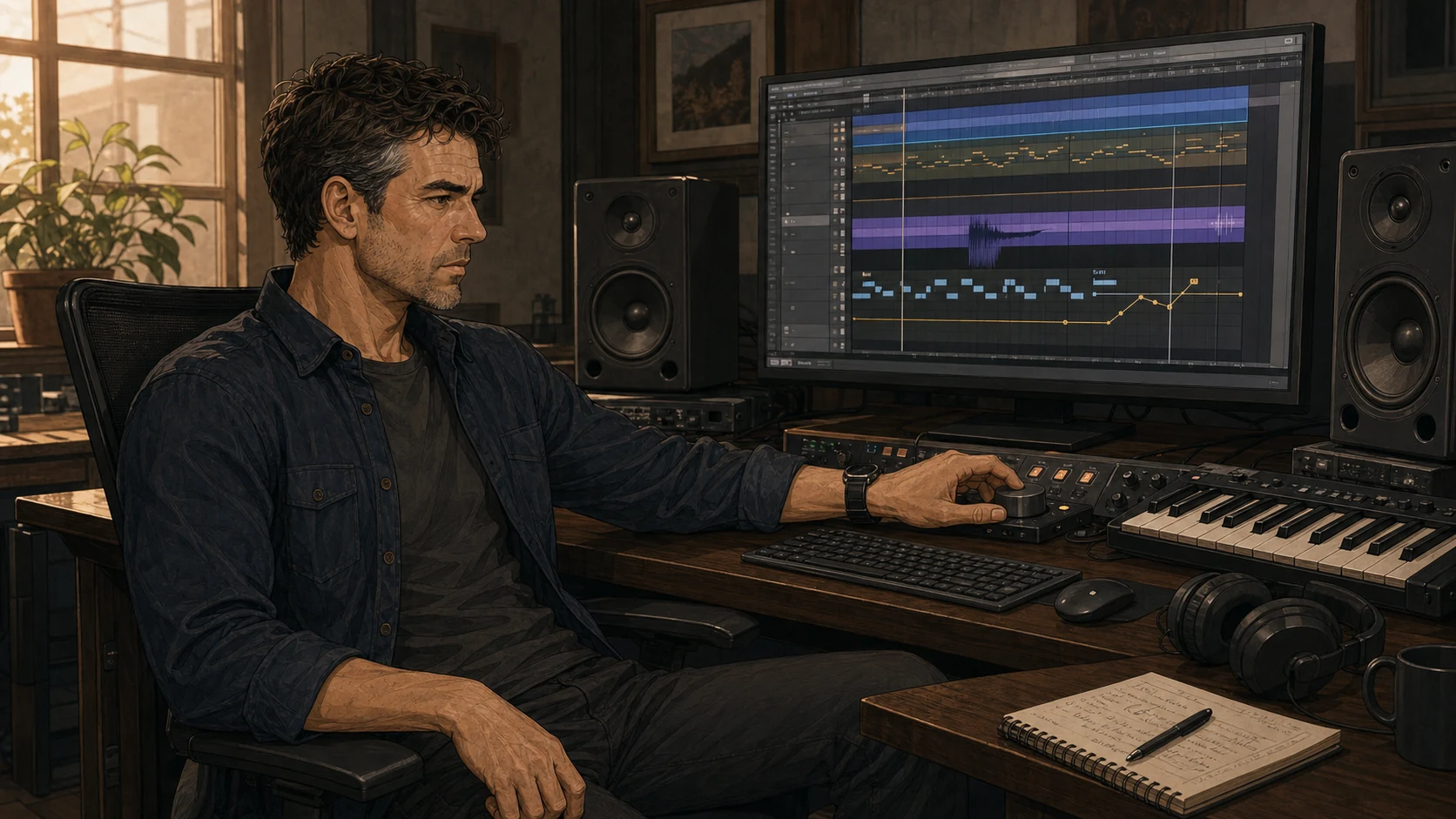
Suno has added MIDI, recording, automation, effects, stems, synthesis, and a project-aware AI assistant to Studio. That is enough to take it seriously as production software. It is also enough to start holding it to production-software standards.
By Nate Mercer, an ACL Tracks editorial voice focused on production quality, workflow control, reliability, and serious-use evaluation


Studio 2 has crossed a line.
I mean that positively.
Suno is no longer asking to be judged only as a system that generates a song from a prompt. Studio now has MIDI tracks, a piano roll, audio recording, automation, stem separation, real-time effects, a wavetable synth, hardware MIDI support, Take Lanes, audio-to-MIDI conversion, and a project-aware Chat Bar that can modify the session and build internal effects.
That is a serious feature list.
It also creates a problem for Suno, because once software starts behaving like a DAW, I stop giving it generator rules.
A generated song can be surprising. A generated guitar part can be strange. A new performance can come back different from what I expected. Fine. That uncertainty belongs to the creative side of the system.
Timing, routing, monitoring, recall, export, and synchronization are different.
Those are infrastructure.
I do not need infrastructure to surprise me.
And that is why Studio 2 still is not replacing my DAW.
Not because AI does not belong in production. It clearly does. Not because a browser cannot become a serious music environment. That argument was old before Studio 2 launched.
The issue is simpler.
Suno has built enough production control that I can finally ask the question that matters:
What happens when I depend on it?
The feature list is finally serious
There is a lot here that I like.
Native MIDI is probably the biggest change because it gives Studio a deterministic layer underneath the generative one. Notes can be recorded, drawn, resized, quantized, velocity-edited, and manipulated through pitch bend and modulation. Hardware MIDI controllers can connect through Web MIDI, and MIDI Learn can map physical controls to Studio parameters.
That matters.
Prompting is useful, but sometimes I already know the notes.
If I want a particular rhythm, chord voicing, bass movement, or melodic contour, describing it in increasingly specific English is not an improvement over playing or drawing it.
Studio 2 understands that.
More importantly, MIDI can become generative input. You can establish musical information first, then ask Suno to reinterpret it as audio.
That is an AI workflow I can take seriously because the human decision does not disappear when generation starts.

Automation is another important addition.
Track volume, pan, and eligible effect parameters can change over time. Those moves are included in exported mixes and stems. That sounds ordinary because mature DAWs have trained us to expect it.
Good.
Ordinary production controls are not boring when their absence prevents you from finishing something.
Studio also has a proper first-party effects environment now, with compression, EQ, reverb, convolution, delay, distortion, gating, and custom effects created through Studio Chat. It has audio recording. It has latency calibration. It has upgraded stem separation. It has a programmable wavetable synth.
This is no longer a toy editor hanging off the side of a generator.
But having the parts is the beginning of this evaluation, not the end.
Timing is not a footnote
The timing issue is the first thing I would put pressure on.
Suno’s own Studio 2 documentation acknowledges that newly generated material can sometimes land slightly ahead of or behind the beat. Its recommendation is to check new material against the metronome and solo the affected part.
That is a reasonable workaround.
It is also a production problem.
There is an important distinction here.
If Suno generates a guitar phrase with a slightly lazy pocket because that performance feels good, I may want it exactly where it landed.
That is musical timing.
If the system intends to place a generated clip on the beat and the clip arrives offset because the production pipeline is not consistently aligning it, that is not feel.
That is infrastructure.
Studio 2 makes this issue more important by adding MIDI.
The whole appeal of MIDI-to-generated-audio is that precise musical information can constrain a probabilistic system. I can specify the notes and rhythm, then let generation solve the performance and timbre.
Good idea.
But the relationship only works cleanly if the deterministic and probabilistic sides agree about where the beat is.

Warping and clip editing can correct a problem after it appears. That is useful.
It is not the same thing as the problem not appearing.
This is one of those places where “AI” should not lower the standard. Creative variation is allowed to be unpredictable. The transport should not be.
MIDI gets Suno closer to production, but precision still has to be earned
MIDI is also where Studio 2 makes its strongest argument for becoming something beyond a song generator.
There is a real production loop available now:
play or draw something, edit the notes, generate an audio interpretation, choose between takes, adjust the source, generate again, then arrange the result beside recorded and generated material.
That is interesting because it moves some control upstream.
Instead of asking the model to solve melody, rhythm, instrumentation, performance, and sound from one description, you can lock part of the musical intent first.
I like that direction.
Studio also supports audio-to-MIDI, which pushes the workflow the other way. Recorded or imported audio can become note information that can then be edited or used elsewhere in the project.
Those two paths together are more important to me than another prompt box.
But I would not call the MIDI side production-ready based on the feature list alone.
There are still questions that documentation cannot answer for me.
How consistently does MIDI-to-audio preserve rhythmic intent across different material?
How dependable is hardware performance under different browser and interface setups?
What does latency feel like after calibration?
How accurately do larger arrangements stay aligned as a project grows?
Those are test questions.
ACL Tracks has not performed those tests yet, so I am not going to pretend I know the answers.
The fact that I want the answers is a compliment to Studio 2.
Studio has finally built something worth testing that hard.
Recording needs more than a calibration button
Audio recording belongs in the same category.
Suno documents support for recording through compatible audio hardware and provides latency calibration. The calibration process measures recording offset and compensates for it.
That is sensible.
What Suno does not currently publish is a numerical round-trip latency specification.
There are no documented buffer settings in the material reviewed for this article. No published residual latency after calibration. No detailed matrix showing performance across browsers, operating systems, interfaces, and project loads.
That does not mean recording is bad.
It means I cannot grade something I have not been given enough information to grade.

This distinction matters.
A calibration feature tells me Suno recognizes the problem.
It does not tell me the size of the remaining problem.
For casual overdubs, that difference may not matter much.
For tighter performance work, monitoring, layered vocals, percussion, or anything else where timing between what you play and what you hear affects the performance itself, it matters a great deal.
Studio has moved into recording territory.
Now I want recording numbers.
No VSTs or Audio Units is still a major wall
The plugin limitation is easier to evaluate because Suno is clear about it.
Studio 2 cannot host VST or Audio Units.
That is a substantial limitation.
I do not say that because every producer needs 400 plugins or because a DAW is somehow defined by how many compressors it can collect.
The problem is workflow continuity.
People build production systems around instruments, processors, metering, repair tools, pitch correction, reverbs, mastering chains, control surfaces, and routing they already understand.
A mature plugin ecosystem lets those tools move with the producer from project to project.
Studio currently asks you to leave that ecosystem outside.
The interesting counterargument is that Suno is building its own.
Studio Chat can generate internal effects from natural-language requests. Those effects can expose parameters, live in the real-time effects chain, support automation and MIDI Learn, and be saved for reuse.
That is genuinely interesting.
It may eventually become one of Studio’s strongest features.
But it does not erase the difference between:
“Build me an effect that behaves roughly like this.”
and:
“Open the processor whose behavior, metering, recall, presets, and failure modes I already know.”
Generated DSP has to earn trust like any other DSP.
Maybe more, because the processor itself can change according to a language request.

I would absolutely experiment with a Chat-built processor.
I would not automatically put one across something critical because the controls have convincing labels.
Useful and trustworthy are not synonyms.
Studio Chat is more interesting because it can change the session
Studio Chat itself deserves credit.
Most AI assistants inside creative software have an obvious failure mode: they know how to talk about the work without really participating in it.
Studio Chat is more ambitious.
Suno describes it as project-aware. It can receive context from the session, work with selected tracks, generate MIDI and audio, modify clips, navigate the interface, and build effects. Its actions go through the same project action system and can be undone.
The undo part matters almost as much as the AI part.
If an agent is going to modify a production session, reversibility is not optional.
That is exactly the kind of design decision that moves AI from demonstration toward production.
I do not need an assistant that is always right.
I need an assistant that can be wrong without damaging the session.
That is a much more useful standard.

There are still obvious questions about consistency, especially with generated effects and more complex edits, but the architecture makes sense.
Suno is not merely putting a chatbot beside a workstation.
It is giving the assistant access to production state.
That is worth watching.
Export is why I would actually use Studio alongside a DAW
This is where the current product starts making practical sense to me.
Studio can export full songs, selected ranges, multitracks, and stems. Suno documents high-quality Studio multitrack and stem exports at 32-bit/48 kHz.
That is enough to establish a credible file-based bridge into another production environment.
And right now, that bridge is important because Studio does not provide direct DAW synchronization or a plugin-host connection.
You leave through files.
That is not elegant, but it is workable.
I can see the shape of the workflow immediately:
generate or restructure material in Studio, use the parts of Studio that are uniquely good at generation and transformation, then export the useful material and finish where deeper routing, established plugins, metering, editing, or mastering are already available.
I would rather have a good export path than a bad attempt at pretending the outside world does not exist.

There are still details I want nailed down.
The current Studio 2 documentation does not fully specify every export-related behavior. MIDI export, for example, is not documented as clearly in the new FAQ as the audio export paths. Internal engine sample rate, resampling behavior, dithering behavior, and several other technical details also remain unpublished.
But the basic strategy is sound.
Suno does not need to replace my DAW to become useful to me.
It needs to give me something valuable enough to bring into it.
That is a lower bar in one sense and a much higher bar in another.
The missing specifications matter more now
A song generator can get away with hiding a lot of engineering detail.
A production environment cannot.
Suno currently does not publish several specifications I would normally want when evaluating a serious audio system.
Among the information not clearly documented in the material reviewed:
- numerical round-trip latency
- engine buffer settings
- maximum simultaneous track count
- maximum effect-instance count
- internal DSP precision
- internal audio-engine sample rate
- project-duration limits
- large-project performance
- crash and recovery behavior
- detailed CPU scaling
- offline project behavior
- advanced routing limits
- full plugin-delay-compensation behavior
Again, unspecified does not mean bad.
It means unspecified.
That distinction is important because it prevents two opposite mistakes.
The first is assuming the system cannot do something because Suno has not documented it.
The second is assuming it can do something reliably because the interface looks like a DAW.
Neither is good evaluation.

Suno has made Studio technical enough that this information now matters.
That is another strange compliment.
Nobody asks a novelty generator about DSP precision.
You ask because the software is starting to occupy a different role.
Routing and interoperability are where mature DAWs still feel mature
A DAW is not just a timeline with more buttons.
The boring plumbing matters.
Signal flow.
Buses.
Returns.
Sidechains.
Monitoring.
External hardware.
Plugin delay.
Control surfaces.
Flexible input and output assignments.
Project exchange.
Reliable state recall.
Those systems are not exciting in a launch video because most of them exist to make sure nothing exciting happens unexpectedly.
That is exactly why they matter.
Suno’s documentation does not currently establish the same depth of routing, synchronization, third-party integration, or engineering transparency available in mature desktop production environments.
That gap is not an insult.
Studio 2 shipped five days before the research cutoff for this article.
It would be strange if a browser-based AI production environment suddenly matched decades of accumulated DAW infrastructure in one release.
The mistake would be pretending that it already has.
Studio 2 does not need to win a DAW checklist
This is where I probably sound more sympathetic to Suno than some people expect.
I do not think Studio needs to beat Ableton, Logic, FL Studio, REAPER, Pro Tools, or Cubase at being those products.
That would be a boring goal.
Those DAWs already exist.
What Suno has that they do not have in the same form is a production architecture built outward from generation.
MIDI can become a prompt.
Audio can become MIDI.
A project-aware agent can edit the session.
A sentence can become an internal real-time effect.
Generated performances, conventional synthesis, recorded audio, stems, automation, and manual editing can occupy one environment.
That is the interesting part.
Suno should keep developing that.
But a different architecture does not remove the need for dependable infrastructure.
If anything, it makes reliability more important because there are more transitions between deterministic and generative behavior.
I do not want Suno to become my DAW by copying my DAW.
I want it to become good enough that there are fewer reasons to leave.
Those are different goals.
Useful, impressive, or production-ready?
So where does Studio 2 land?
Useful? Yes.
The ability to move generated material into a multitrack environment, work with MIDI, record audio, automate parameters, separate stems, create effects, and export high-resolution multitracks gives Studio obvious practical value.
Impressive? Absolutely.
MIDI-to-generated-audio, project-aware Chat, internal AI-built effects, and the combination of deterministic production controls with generative audio are not trivial additions.
Studio 2 is doing something meaningfully different.
Production-ready as a complete replacement for a mature DAW? Not yet.
The timing issue alone deserves attention. Add the closed third-party plugin environment, absence of direct DAW synchronization, limited published information about latency and engine behavior, and unanswered questions around project scaling and deeper routing, and I do not see a reason to move the finishing end of my workflow out of a mature DAW.
That does not make Studio 2 a failure.
It tells me where I would put it.
At the front of the process, it looks increasingly powerful.
In the middle, it is becoming genuinely interesting.
At the final production and finishing stage, I still want the control and predictability of the environment I already trust.

Suno does not need me to abandon my DAW for Studio 2 to matter.
If Studio gives me musical material, control, and generative workflows that are difficult to get elsewhere, I will happily use the useful parts and export when I hit the wall.
The more interesting question is how often that wall appears.
Right now, it appears too early for me to call Studio a full DAW replacement.
But for the first time, I think Suno has built something where that question is worth asking seriously.
That is progress.
And now that Studio 2 wants to sit at the production desk, I am going to judge it like it belongs there.
Sources and verification notes
Material product claims in this article are based on ACL Tracks research verified through August 18, 2026, with primary product claims drawn from official Suno documentation.
Primary references:
- Studio 2.0 release notes — release timing and major Studio 2 changes.
- Introducing Studio 2.0 — MIDI-to-audio generation, Studio Chat, effects, automation, export quality, and product positioning.
- Introducing Suno Studio 2.0: technical overview and FAQ — environment requirements, MIDI/audio workflow, stem separation, recording, exports, VST/AU limitation, DAW interoperability, and acknowledged generated-clip timing behavior.
- MIDI in Studio — MIDI recording and editing, hardware control, transport behavior, and MIDI Learn.
- Recording in Studio — audio recording and latency-calibration behavior as documented in Suno’s Studio recording guidance.
- Audio Effects and Plugins in Suno Studio — factory effects, real-time processing, Chat-built internal effects, automation, reuse, and lack of VST/AU hosting.
- Automation in Studio — volume, pan, plugin-parameter automation, MIDI control, and export behavior.
- Suno pricing — Premier-only Studio access at the research cutoff.
- Suno invite friends — Invite people and earn credits.
Editorial interpretation: The judgments that Studio 2 is now serious enough to evaluate as production software, that infrastructure should be held to a different standard than creative generation, and that Studio currently makes the most sense as a generative production environment paired with a mature DAW are Nate Mercer’s editorial analysis.
ACL Tracks has not supplied evidence of a hands-on Studio 2 production test for this article. The article therefore does not claim that Nate personally measured latency, tested project scaling, compared exports, stress-tested generated effects, or completed a production inside Studio. Questions requiring those experiments are explicitly left unresolved.
