
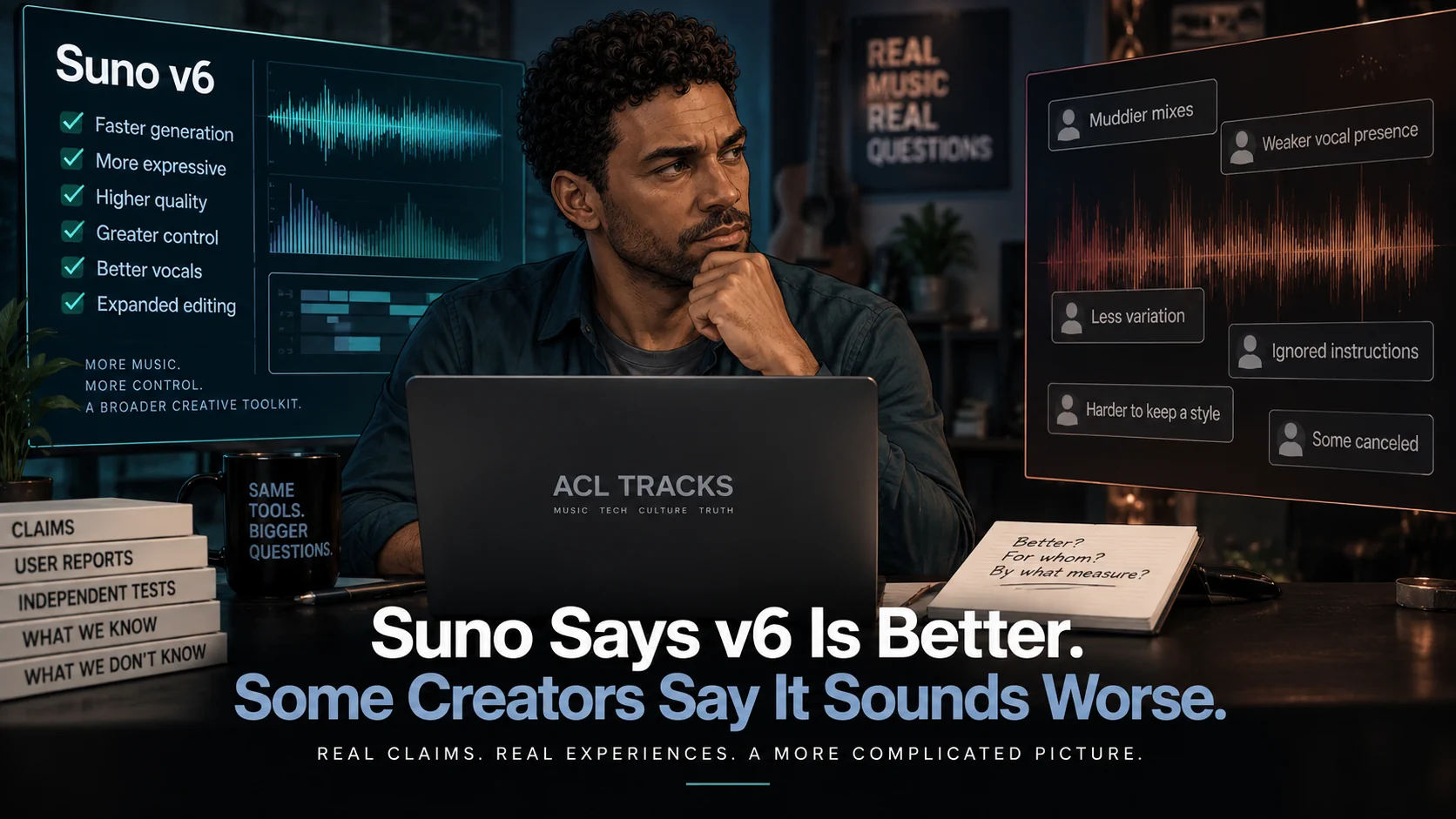
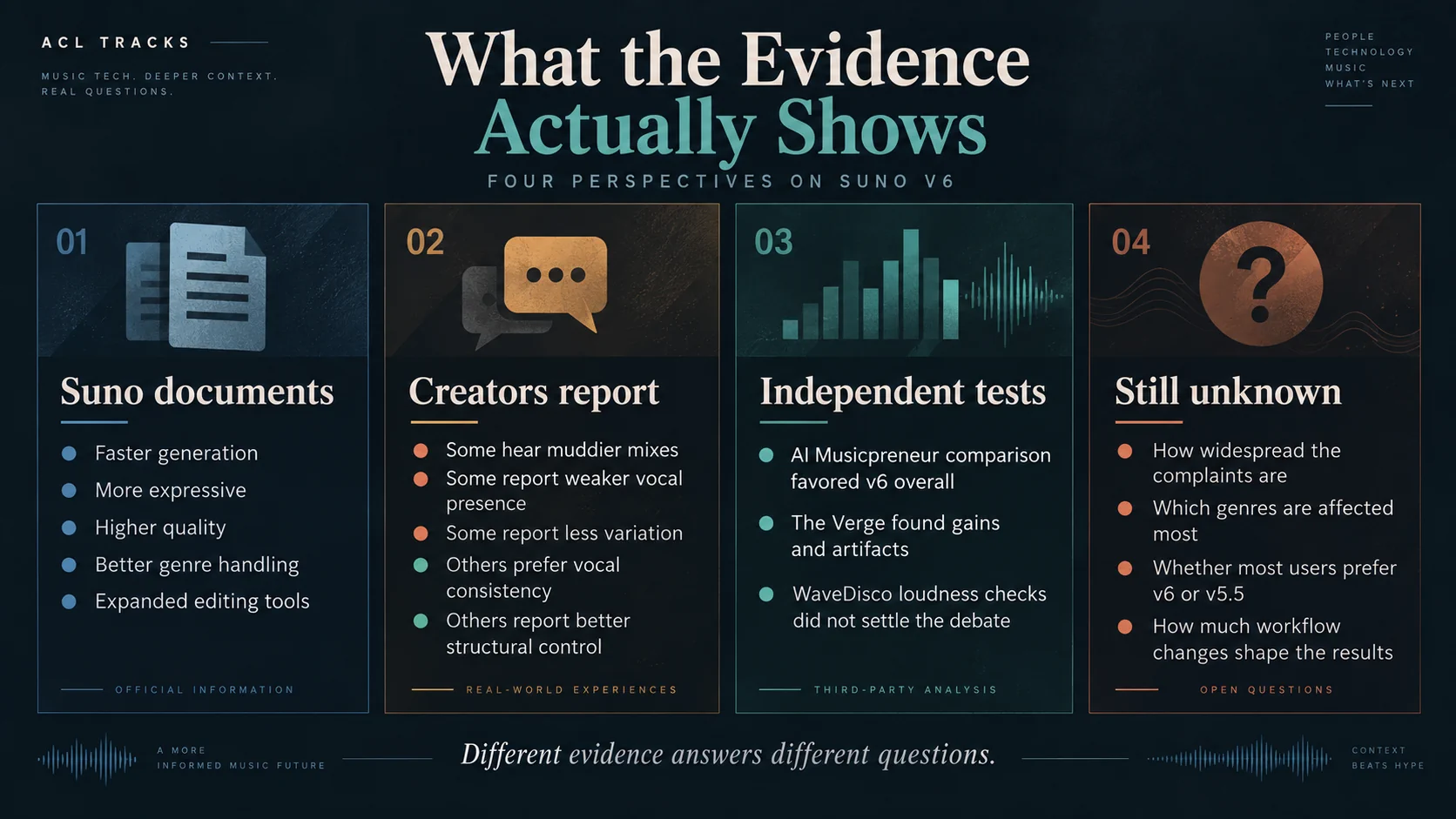
When Suno launched its new generation of music models on September 9, 2026, it described them as faster, more expressive and higher quality than what came before. The company positions the flagship v6 model as a way to deliver polished results with greater precision. It describes v6-wild as favoring experimentation over some of that predictability, while v6-mini brings the new generation to free users.
Suno also says v6 better understands vocals, instrumentation, structure, mood and musical references. Its listed capabilities include localized edits with natural-language instructions, combining material from several sources, working from text, audio, images and video, and changing individual lyrics without rebuilding an entire song.
Those capabilities do not settle a separate question: does v6 sound better? Creator reports point in different directions, and the independent comparisons available so far do not support a simple verdict.
Why some creators say v6 sounds worse
A recurring complaint about v6 is that it sounds muffled. Creators describe vocals sitting behind the instruments, crowded low and low-mid frequencies, reduced clarity and mixes that feel less open than those from the previous generation.
One creator who preferred v6’s instrumentation said banjo, fiddle and guitar performances had improved in their generations, even as the overall mix became muddier and the instruments competed with the drums and bass.
Other complaints concern creativity. A longtime user who reported roughly 7,000 Suno songs and generations said repeated attempts with the same material produced similar melodies, chord movements, phrasing, arrangements and endings. In that user’s experience, v6 felt more repetitive and predictable than earlier models.
Creators have also reported ignored tempo instructions, unwanted instrumentation and difficulty preserving vocal or stylistic identities they had developed around earlier models. Some say the change was significant enough for them to cancel or reconsider their subscriptions. MusicRadar and Digital Music News covered the backlash after launch.
These reports document negative reaction, but they do not show how widely that view is held. The evidence discussed here includes no published survey of Suno subscribers measuring preference for v5.5 against v6. Reddit votes and cancellation announcements in a discussion thread are not representative samples.
The backlash is documented.
Its size is not.
Other creators report improvements
Some creators prefer v6. One person using Suno to maintain fictional artists across multiple songs reported that it was substantially better at keeping a vocalist recognizable while changing genre, emotion, arrangement and vocal delivery.
Another user initially disliked the new model because it seemed unable to reproduce a familiar style. After changing their workflow and using Suno’s My Style feature, that user reversed their assessment and reported better structural and production-direction adherence than with the previous model.
Other reports are mixed. One producer described improved bass weight, stereo width and overall production in some generations while still finding the vocals difficult to direct. Another reported strong structural adherence and surprisingly specific vocal behavior, but questioned the consistency of memorable hooks.
Different priorities may help explain some of the disagreement. A creator who values consistent vocal identity may experience an upgrade, while someone who values unpredictable melodic variation may experience a downgrade. Both can be describing their own results.
What independent comparisons found
Christopher Wieduwilt at AI Musicpreneur conducted a direct comparison using the same lyric, the same cloned voice and the same seven style prompts across v5.5 and the three v6 variants. The test produced 27 audio files.
Wieduwilt’s conclusion favored v6. He reported stronger vocals, better instrumental results in several genres and dramatically faster generation. He also found weaknesses: guitar and bass stems remained problematic, some harder material produced artifacts, and v6-wild could push a cloned voice farther from its original character.
That comparison does not prove v6 is universally better. It shows that a structured test using consistent source material can produce results that contradict the broadest version of the downgrade claim.
The Verge’s hands-on testing found meaningful improvements in v6’s ability to recognize and express characteristics associated with genres including hyperpop and krautrock. But AI-related vocal artifacts remained, and the model struggled when asked to produce musical imperfections such as dissonance, sloppy rhythm or off-key performance.
The Verge also found less practical difference between v6 and the supposedly more unpredictable v6-wild than Suno’s descriptions might suggest. Better genre handling can coexist with persistent artifacts, just as stronger instruction-following in one workflow can coexist with less interesting variation in another.
What the measurements can and cannot show
WaveDisco approached the comparison through measurement. Its test used three songs generated across model variants with matching lyrics and prompts, then measured integrated loudness and true peak.
The results did not show a consistent pattern establishing that v6 was louder, quieter or clearly more controlled than v5.5. One difference did appear: in the tested v5.5 tracks, WAV and MP3 downloads differed noticeably in loudness and peak behavior. That difference essentially disappeared across the tested v6 variants.
The author describes the three songs as an illustration, not a study. And loudness measurements cannot settle the complaint that v6 sounds muffled. “Muffled” usually refers to tonal balance, clarity or masking. Two tracks can have nearly identical integrated loudness while differing substantially in frequency balance and vocal presence.
The measurements therefore neither confirm nor disprove the muffling reports. They address a different question.
Why comparisons with v5.5 may get harder
When v6 launched, Suno said it would retire the previous generation and move the platform onto v6. Its current model documentation now centers on v6, v6-wild and v6-mini.
That could make it harder for someone who preferred v5.5 to keep using it while researchers build larger comparisons. Existing comparison sets created while both generations were available may become more valuable, since recreating the same experiments later may no longer be possible.
That limitation calls for care in drawing conclusions.
Better depends on what is being judged
Suno has made real changes with v6. Its current generation provides capabilities the previous system did not, and independent testers have documented improvements in generation speed, genre handling, vocals and arrangement behavior. Separate creator accounts describe muddier mixes, weaker vocal presence, reduced variation and inconsistent instruction-following.
Independent testing does not support describing v6 as a universal downgrade. The favorable comparisons do not establish a universal upgrade, either. Nor does the evidence show that every complaint is user error, bad prompting or resistance to change. These comparisons and creator reports do not establish what percentage of Suno users prefer one generation over the other.
“Better” can mean fidelity, vocals, genre recognition, instruction-following, creative variation, editing, preserving a musical identity or surprising the listener. Those are not the same test. Suno can improve substantially in some of them while making another creator’s preferred workflow less effective.
A creator can also sincerely dislike v6 without establishing that the model is technically worse overall. For now, the interesting part isn’t choosing which side gets the last word. It’s figuring out exactly what each side is hearing.
