By Adrian Cole · ACL Tracks
Series: SunoAI
Verified: September 8, 2026
The limits count songs, not individual files. Studio has a separate export rule. Commercial permission remains a different question from copyright protection. (Suno Help)

suno-download-limits-2026-policy-now-activeSeptember 3 has passed.
Suno’s new download rules are operative. Its Terms list September 3, 2026 as their effective date. (Suno Help)
The useful question now is what Suno actually counts. A plan allowance cannot tell you, by itself, whether downloading stems spends several downloads, whether unused purchases survive renewal, or whether a file comes with permission to commercialize it.
Those are separate questions. The documentation answers some clearly. Others still need a narrower conclusion.
Pro gets 20. Premier gets 60. Free depends on the account’s age.
The current account states are:
| Account | Included ordinary song downloads |
|---|---|
| Free account created before September 3, 2026 | Up to seven trial downloads, not a monthly allowance |
| Free account created on or after September 3, 2026 | Occasional trial downloads may be offered; seven are not guaranteed |
| Pro | 20 per month |
| Premier | 60 per month, with a separate exemption for Studio workflows |
Both groups of Free users can purchase downloads. Trial downloads do not carry commercial-use rights. (Suno Help)
That Free-account distinction matters. The August 10 FAQ still uses broader trial wording. The September 3 help page—and the footnote now attached to the original announcement—distinguish older accounts from new sign-ups. A universal seven-download promise would be inaccurate. (Suno Help)

Download allowances also sit apart from generation credits. Pricing lists 2,500 monthly generation credits for Pro and 10,000 for Premier, alongside their respective 20 and 60 song downloads. A generation balance is not an export balance. (Suno)
One song is not three downloads
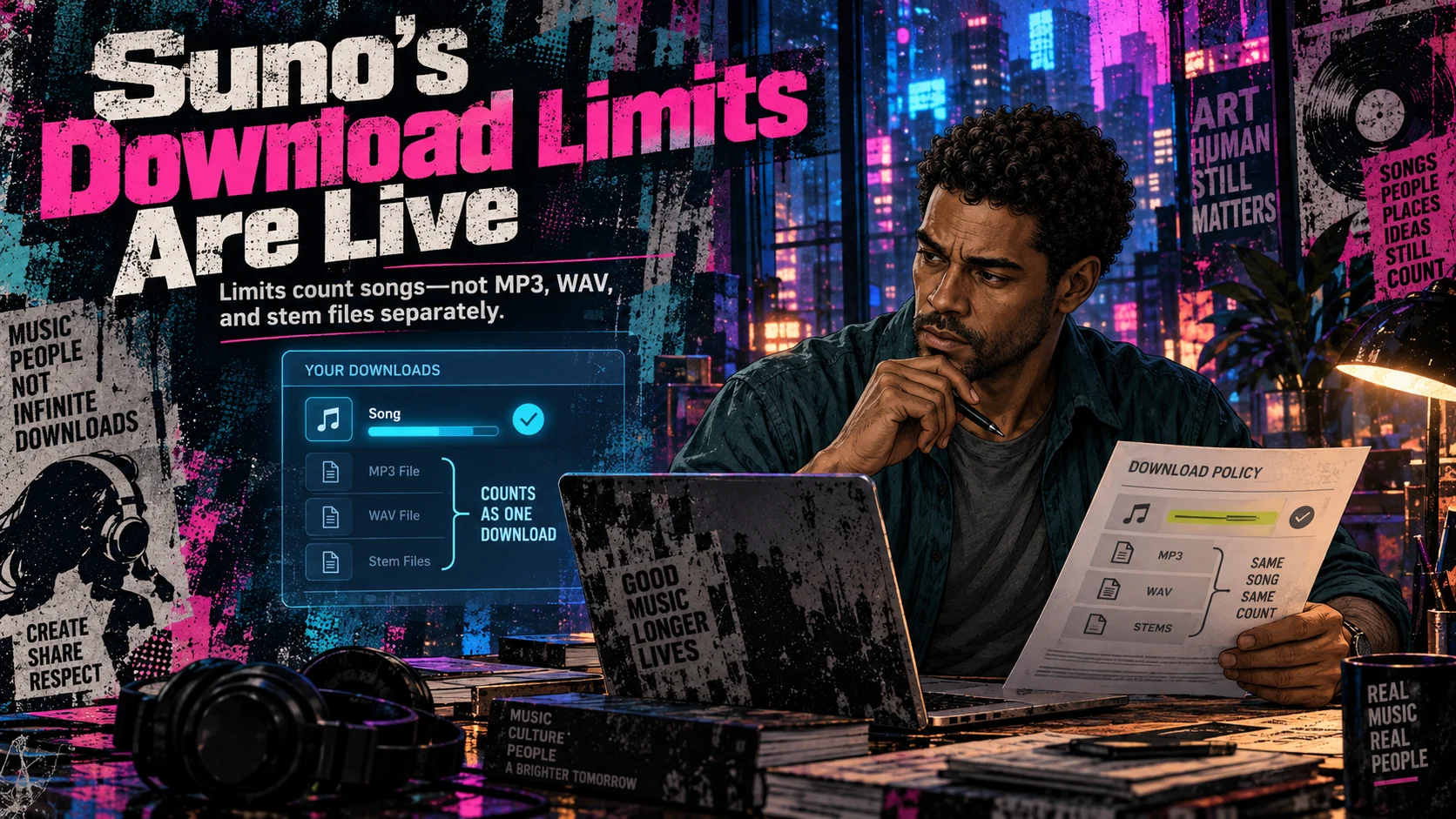
Suno’s detailed FAQ counts a song once, regardless of format. Downloading the same song again does not spend another allocation. Its stems belong to that song’s download, and failed or interrupted downloads do not count. (Suno Help)
For example, downloading one song as MP3, then WAV, then its available stems uses one song-level download—not three. (Suno Help)

suno-one-download-wav-mp3-stemsThe important condition is the same song. The FAQ does not comprehensively define how separately generated or edited versions are identified for counting. Two distinct library entries should not be assumed to share an allowance merely because they came from the same idea. (Suno Help)
There is no blanket exemption for older creations. The rules cover downloads of songs made before September 3 as well. Suno says the existing library remains playable and shareable on its platform; access inside Suno and taking a file off-platform are different things. (Suno)
Subscription allowances expire. Purchased downloads roll over.
Unused monthly download credits do not carry forward. An annual subscription still receives monthly allocations following its original purchase date, rather than the year’s downloads all at once. (Suno Help)
Purchases work differently. Individual downloads and download packs roll over. Unused trial downloads also carry forward, but they do not replenish each month. (Suno Help)
“Roll over” is the documented promise. That page does not establish every possible expiry condition or a universal pack price. I would keep the claim there rather than silently expanding it to “never expires under any circumstances.” (Suno Help)
There is another easy source of confusion: Pricing says purchased generation-credit top-ups do not expire but require an active subscription to use. That statement concerns generation credits. It should not be copied across to purchased downloads as though the two balances had identical conditions. (Suno)
Commercial permission is not copyright protection
The paid-rights help page, updated September 3, describes commercial-use rights for songs downloaded while subscribed. It lists uses including streaming distribution, film, television, games, and direct sales. (Suno Help)
That is permission from Suno to commercialize qualifying material. It is not a determination that copyright protects every part of the result. Suno’s September 4 copyright guidance explicitly says material made on paid plans may still be ineligible for copyright protection. (Suno Help)

The operative Terms require a permitted Download through a Suno-approved channel, within the applicable allocation and conditions, before commercial exploitation. Recording or ripping a stream is prohibited as an alternative. (Suno)
The Terms assign Suno’s rights in qualifying paid-account output while keeping commercial-use restrictions as separate contractual obligations—even where no copyright exists. Assignment does not erase those obligations or clear rights to material you submit. (Suno)
Nor does Suno’s permission guarantee acceptance elsewhere. Its September 8 Believe/TuneCore announcement ties the new distribution eligibility to music made with the forthcoming industry-partner model. That is not blanket clearance for every existing Suno track. (suno.com)
Already obtained rights do not reset with the allowance
The Terms make assignments and commercial-use rights attached to an obtained Download perpetual: exhausting the allowance, later allocation or pricing changes, and subscription expiry, cancellation, downgrade, or suspension do not revoke them. Remix restrictions remain. (Suno)
Suno’s older ownership FAQ also says commercial rights are retained after cancellation. Its creation-focused explanation must now be read alongside the download requirement, rather than substituted for it. (Suno Help)
The practical distinction is between the next download and rights already obtained.
Remixes and older Free songs need separate attention
The Terms’ defined cross-user Remixes are personal/noncommercial by default, even on paid plans or after a permitted Download, unless a separate offering provides otherwise. Where copyright exists, the original creator and Remixer own these Remixes jointly and equally. (Suno)
That is not a blanket ban on editing your own song. Suno’s older Remix FAQ separately discusses monetizable self-remixes from eligible paid originals. It does not give permission to monetize someone else’s track simply because remixing was enabled. (Suno Help)
Older Free-plan songs expose a different documentation gap. The September 3 paid-rights page speaks about downloads while subscribed; the December 17, 2025 retroactive-rights FAQ says upgrading does not automatically license earlier Free creations. The pages do not clearly reconcile every old-song/redownload scenario under the revised framework. That gap is not evidence of automatic commercial clearance. (Suno Help)
The Terms also retain a noncommercial restriction for Free-tier output. The purchase documentation does not identify a separate commercial-rights exception for a Free user buying extra downloads. A purchase offer alone is not evidence of that exception. (Suno)
Studio is an exemption, not a synonym for Premier
Studio 2.0 is available to Premier subscribers. Its launch documentation explicitly describes unlimited Studio multitrack and stem exports; the current download help page exempts Studio workflows from download limits. This is a published exception, not an inferred workaround. (Suno)
The Studio technical FAQ documents exports of a full project song, selected ranges, multitracks, and individual stems. Those are the workflows being discussed—not a claim that every download anywhere on a Premier account is unlimited. (Suno Help)

suno-studio-download-limit-exemptionPremier therefore has two different export situations: ordinary song downloads under the 60-per-month allowance, and exempt Studio workflows. Leaving out either half would misdescribe the plan. (Suno)
The exemption concerns download limits. It does not establish unlimited generation or settle the rights in the material being exported. Those questions still require their own answers. (Suno)
The policy changed. The replacement-model transition is separate.
The August 10 announcement put a September 3 date on download limits and revised Terms. It tied retirement of prior models to the launch of replacement models instead. Those were not one deadline. (Suno)
As of September 8, Pricing still lists v5.5 as the latest paid model. Suno’s announcement that same day still describes the replacement models as forthcoming. The current first-party evidence supports v5.5 remaining listed; it does not establish a completed replacement-model launch. (Suno)

The promised retirement also should not be confused with deletion of existing creations. Suno says songs already made will remain in the library when the new models arrive. (Suno)
But “the new models are not confirmed as launched” does not mean nothing else has happened. The September 8 announcement says Suno has recently introduced audio watermarking and fingerprinting. That establishes the company’s implementation claim, not an ACL Tracks forensic inspection of every downloaded file. (suno.com)
For material headed into commercial use, I would keep the song identifier, the qualifying download record, the relevant subscription or purchase record, and the dated policy relied upon. Not because a folder creates rights, but because it preserves which permission you thought you had.
The older Free-song edge case and the full conditions of download purchases need clearer documentation. Until then, a source that proves one permission should not be made to stand in for all of them.
Verification note: This article reviews first-party documentation available on September 8, 2026, including Suno’s announcement that day. It does not claim account-level testing, contact with Suno, or legal advice. Illustrations are conceptual editorial artwork, not product screenshots.
