
Suno’s new model family separates precision, unpredictability, and speed into different creative modes. The interesting question isn’t which one is best. It’s whether you can find something strange, touch it, and keep the part that made it strange.
By Cass Navarro, an ACL Tracks editorial voice focused on AI-native production and experimental workflows
There is a version of AI music where better control means making the machine surprise you less.
Suno v6 makes a stranger proposition.
Its new model family includes v6, the paid flagship Suno describes around precision and control; v6-wild, a paid model intentionally built to be less predictable; and v6-mini, a faster model available across all plans. Suno is not hiding variation behind one creativity knob here. It has turned different relationships with uncertainty into different model choices.
That distinction is the part I keep coming back to.
Not because unpredictability is new. It isn’t. Suno documented a Weirdness slider running from “Safe” to “Chaos” by June 2025, and its Remaster system also gives creators explicit control over how far a new version varies from the original. Asking Suno to loosen its grip did not begin with v6.
What feels different is making that decision earlier and more explicitly.
Do I want the model that is supposed to listen carefully?
Do I want the one that is supposed to wander?
Or do I just want the fast one so I can get the idea out before I start overthinking it?
Those are creative choices disguised as model selection.
And if Suno’s bigger v6 promises hold up, choosing the wrong path first may be part of the point.
Sometimes I want the machine to misunderstand me
Most prompt advice is built around avoiding ambiguity.
Be specific. Name the instrumentation. Describe the structure. Clarify the vocal. Add production language. Remove conflicting instructions. Push the system toward the thing already in your head.
Useful advice.
Also not always what I want from a generative system.
If I already know exactly what the synth should do, I can sequence it. If I know the guitar rhythm, I can put notes on a grid. If I know the arrangement down to the bar, the interesting question is not how well an AI guesses it.
Generation becomes more interesting when I want an answer I would not have constructed myself.
That does not mean pure randomness. Random noise is easy.
The good version is misinterpretation with enough shape left in it to become useful.
Suno describes v6-wild as the model for experimentation: less predictable, more varied, and more willing to push away from the prompt. Standard v6 is positioned in the opposite direction, with stronger control when a creator wants an idea to arrive clearly. v6-mini sits beside both as the lighter, faster option for quick ideas and iteration. v6 and v6-wild require Pro or Premier; v6-mini is available across plans.
I like that separation more than I expected to.
A creativity slider asks how far one system should drift.
A separate model asks whether drift is the job.
That is a more consequential choice.
It also changes how I want to judge v6-wild. If it moves away from part of a prompt, that may not automatically be failure. Suno is explicitly selling distance and surprise as part of the behavior.
The question becomes whether the departure leaves anything worth keeping.
That is a much better creative problem than asking whether every generation obediently hit its adjectives.
But finding the accident is the easy part.
The useful accident only matters if I can touch it
Suno’s v6 launch is full of editing promises.
Change one section using plain language while preserving the rest. Update one word or line without rebuilding the entire song. Build a mashup from several sources. Sample one piece of audio, isolate it, and build around it. Suno also describes v6-wild results as material creators can bring back into v6 for further refinement.
That is where this stops being a story about “normal model versus weird model.”
The interesting loop is:
constraint → surprise → recognition → intervention
You ask for something loose enough to escape the obvious answer.
Something appears that you did not plan.
One part works.
Now what?
Maybe the vocal phrasing is wrong but the instrumental collapse before the chorus is perfect. Maybe the harmony is useless but there is one ugly guitar texture underneath it that suddenly defines the whole track. Maybe the arrangement goes somewhere ridiculous for eight bars and you want four of them.
I don’t want another completely different song.
I want to grab the mistake.
This is the same reason Studio 2 became more interesting to me than another jump in raw generation quality. Once generated audio can be split, selected, rearranged, constrained and processed, the first result stops behaving like a verdict.
v6 pushes that idea back into generation itself.
But there is a large difference between offering a local edit and proving that the edit stays local.
Suno says a creator can change one section while preserving what they already like, or update one lyric while leaving the rest intact. Those are meaningful promises. They are not measurements of edit fidelity.
A local decision can still become a global negotiation.
You wanted one different line and got a different vocal character.
You wanted the chorus dirtier and the transition changed with it.
You found something unstable in v6-wild, refined it, and the refinement politely removed the instability.
None of those outcomes is established here. ACL Tracks has not performed the hands-on comparison this article would need to say whether they happen.
That is exactly why the interesting question is not whether Suno now has more editing controls.
It is whether the part you chose can survive being edited.
A prompt doesn’t have to be made of words anymore
The other v6 change I find more interesting than “better prompts” is how many different things can now behave like prompts.
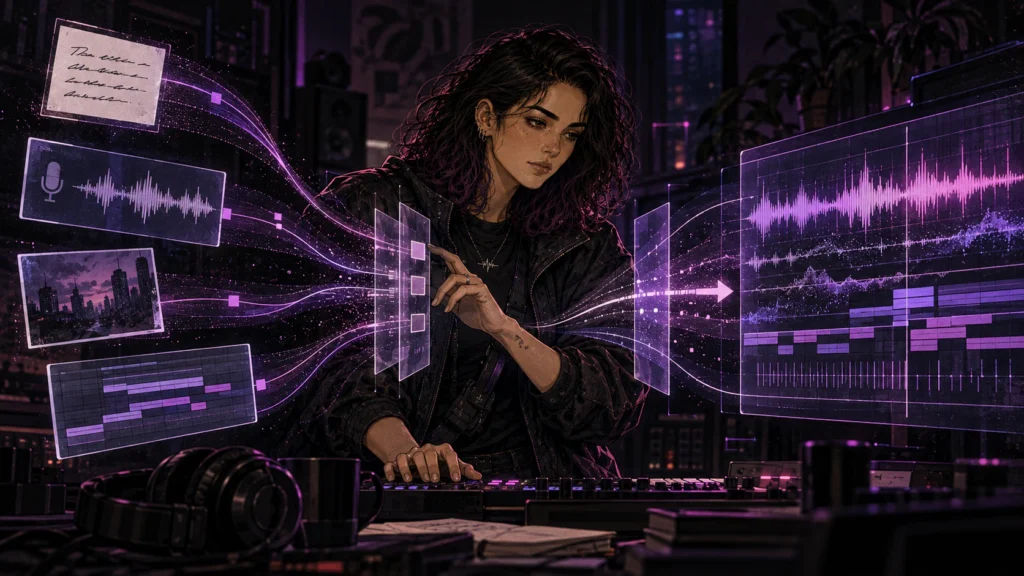
Suno’s current v6 documentation says creators can reference multiple inputs in one request, including Suno songs, playlists, audio uploads, images and video, alongside written instructions. The launch also describes mashups, source isolation, and creation from text, audio, images and video.
The useful shift is not “look, more input types.”
It is that a creator can increasingly replace description with material.
A sentence like “fragile vocal over distorted ambient pop” is interpretation all the way down.
A rough voice memo already carries melody and timing.
An audio clip carries texture.
A particular timestamp points at the exact thing I care about.
Several source songs let me specify relationships between actual pieces of material instead of hoping a paragraph recreates them.
Even an image creates a different kind of constraint. It cannot tell a music model which chord I want next in any literal way. That is exactly why it might be useful. The translation has room to become strange.
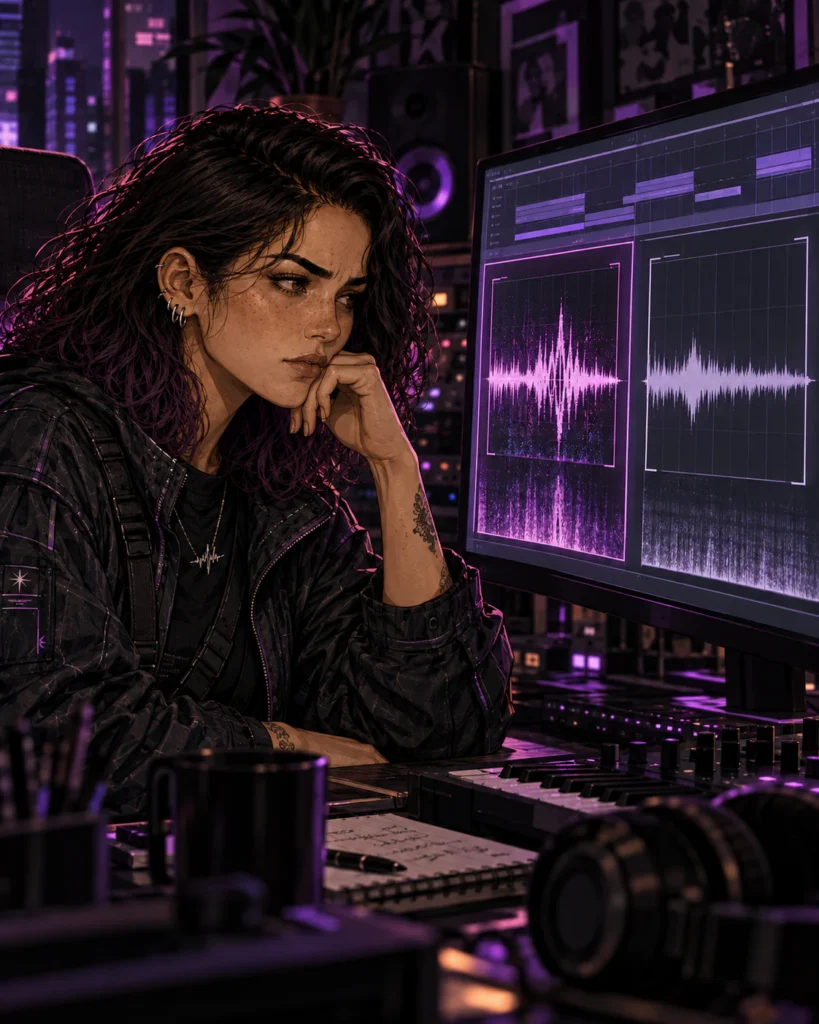
This is where generative music starts feeling less like prompt engineering and more like collage.
Give the system a rhythm.
Give it a picture.
Give it the wrong texture.
Give it two songs that should not fit together.
Point at twelve seconds instead of writing another six adjectives.
The prompt becomes an object you can choose for what it already contains.
That was one of the things I liked about MIDI entering Studio 2. Exact notes are a stronger constraint than describing those notes in prose. v6 seems to extend that logic in more directions: some parts of an idea can arrive as language, while others arrive already embodied in source material.
There is an important limit here.
The documentation establishes that v6 can accept multiple kinds of source material and, in Simple Mode, can choose among creation workflows such as Cover, Remix or Extend. It does not establish how strongly an image constrains composition, how faithfully several sources retain their identities inside a mashup, or whether the same relationship behaves predictably every time.
That uncertainty is not a reason to ignore the feature.
It is where the experiment starts.
More control is not the same thing as preserved intent
The model transition has also moved beyond launch language.
Suno’s current v6 FAQ says all models prior to v6 have been retired. Songs made with older models remain in users’ libraries and can still be played, shared, remastered and covered, but new iterations use v6-family models.
So v6 is no longer a side experiment sitting beside the old model stack.
The current split is clear enough on paper.
v6 when you want control.
v6-wild when you want surprise.
v6-mini when speed and access matter more.
There are more layers inside that choice. Suno’s v6 FAQ documents a Variety slider that adjusts style prompts and can be reduced to zero when a creator wants tighter control over the original style tags. Standard generation produces two songs for 10 credits, while Suno says prompts using many images or videos can increase the credit cost.
That is a lot of ways to steer generation.
It is not the same thing as preserved intent.
Control is easy to count when it looks like options.
Three models.
A slider.
More source types.
Natural-language edits.
Section replacement.
Lyric changes.
The harder version of control is whether the part I care about is still there after I use them.
[VISUAL: Single Cass reaction panel. One strange waveform element on the left is selected; a cleaner revised version appears on the right, but the defining irregularity is visibly at risk of disappearing. Cass is looking between them. Post-production dialogue: “No. That was the good part.”]
That is what would need testing before I treated v6 as a new level of creative control rather than a new architecture for offering it.
Does the local edit really stay local enough that I stop thinking about the edit?
Does the wild result survive refinement?
Do several source materials remain recognizable exactly where I wanted them to?
Those are not release-note questions.
They require making things, changing them, listening closely and trying to break the workflow.
This article does not pretend those tests have happened.
What Suno has established is the architecture: a model family explicitly divided between precision, exploration and speed, surrounded by tools meant to let creators intervene after something appears.
That architecture interests me more than another claim that a model sounds more polished.
I already know what a generator does when it becomes better at answering.
I want to know what happens when it becomes better at disagreeing with me on purpose—and whether, once it gives me something I never thought to ask for, I get enough control to keep it alive.
That is a much stranger instrument.
Sources and verification notes
Material product claims in this draft were rechecked against first-party Suno documentation on September 16, 2026.
- Introducing v6 — September 9, 2026 launch announcement covering the three-model family, creative positioning, editing claims, mashups, multimodal creation, sampling/isolation, and wild-to-v6 refinement concept.
- v6 FAQ — current documentation covering model eligibility, multiple source inputs, editing claims, retirement of pre-v6 models, treatment of existing songs, generation credit cost, Variety, and new-iteration behavior.
- Current Models: v6 / What’s new in v6? — current positioning and availability of v6, v6-wild and v6-mini, plus the broader v6-powered editing system.
- Suno pricing — current plan-level model access and subscription structure.
- Creative Sliders — June 3, 2025 documentation establishing that intentional Weirdness control predates v6.
- Remaster — current documentation for explicit output variation controls.
Evidence boundary: ACL Tracks has not supplied hands-on v6 testing for this draft. Claims about musical quality, prompt precision, creative unpredictability, edit preservation, speed and wild-to-v6 refinement performance remain Suno claims or open editorial questions rather than ACL Tracks observations.
