

Why Universal and Sony Are Suing Suno Again – and What the $9 Billion Headline Leaves Out
Universal and Sony have filed a second case covering 60,202 recordings just as Suno launches a new generation of models built with other music-industry partners. The dispute is no longer only about what went into Suno’s old training data. It is becoming a fight over whether a supposedly clean model can inherit problems from the models that came before it.
By Adrian Cole, an ACL Tracks editorial voice focused on documentation, copyright, licensing, policy, and evidence-based investigation
Excerpt: Universal and Sony are suing Suno for a second time, this time asserting 60,202 recordings and challenging the company’s new v6 models. Suno has acknowledged training earlier systems on enormous amounts of internet music and using YouTube audio. What remains unresolved is whether that copying was lawful fair use—and whether a newly licensed model can actually leave the old legal fight behind.
There are two very different versions of Suno’s current position.
In one, the company has moved into a new phase. Warner Music Group settled its litigation with Suno and became a partner. BMG signed a global agreement. Believe and TuneCore joined shortly afterward. Suno launched its v6 family on September 9, describing it as a new generation of music models developed with Warner, BMG and Believe. Suno has also retired the pre-v6 models from new generation.
In the other version, none of that cleans up what came before.
Universal Music Group and Sony Music Entertainment filed a second federal lawsuit against Suno on September 18. The complaint asserts 60,202 sound recordings and argues that even Suno’s newly licensed v6 models remain connected to earlier systems the labels say were built using their recordings without permission.
Those positions can coexist because Suno’s legal defense has never simply been that copyrighted music was absent from its training data.
The central dispute is whether Suno was legally allowed to use it.
Suno stopped denying the basic training-data question a long time ago
The original major-label lawsuit against Suno was filed on June 24, 2024. Universal, Sony and Warner-affiliated record companies accused Suno of copying copyrighted sound recordings to build its generative-music system. That case identified 560 recordings as an illustrative set rather than claiming those were the only works involved.
Suno’s response made an important distinction.
It did not say the model had been trained only on licensed or copyright-free music.
In its August 2024 answer, Suno said its model had been shown tens of millions of recordings and described its training data as including essentially the music files of reasonable quality available on the open internet, subject to things such as paywalls and password protections. It acknowledged that the material presumably included recordings controlled by the companies suing it.
Suno’s position is that this does not amount to infringement because the copying involved in model training is protected by fair use.
That is an important boundary.
Suno admitting that copyrighted recordings entered its training process is not the same thing as Suno admitting that it infringed copyright.
The first is substantially established by Suno’s own court filings.
The second remains contested.
Discovery made the lawsuit much larger
Once the original case entered discovery, Universal and Sony gained access to information about Suno’s training data.
The labels say they used audio-fingerprinting technology from Audible Magic and identified tens of thousands of additional recordings they control. In May 2026, they asked Judge F. Dennis Saylor IV to amend the existing case to add 61,026 more works.
That request failed.
But the reason matters.
On August 18, Judge Saylor denied the amendment without prejudice because adding more than 61,000 works when fact discovery was approaching its end would dramatically expand and delay the case. He said parallel litigation could better preserve the labels’ ability to pursue the additional claims without derailing resolution of the existing 560-work dispute.
That was a procedural ruling.
It was not a finding that the 61,026 recordings had not been copied.
It was not a finding that Suno’s use was fair.
And it was not a dismissal of those potential claims on their merits.
Universal and Sony followed the route the order left open.
On September 18, they filed a new case in the same Massachusetts federal court. That complaint asserts 60,202 recordings and has been assigned to Judge Saylor. As of September 21, the public docket shows the complaint and initial filings; there has not yet been a merits ruling in the new case.
The YouTube issue is now an admission, not just an accusation
Discovery also produced another development that is easier to state precisely.
Suno obtained training audio from YouTube.
In its September 1, 2026 answer to the amended complaint in the original case, Suno expressly admitted that audio data was obtained from YouTube for training and, responding to one allegation, identified YT-DLP as the tool used.
That admission does not itself decide the separate legal issue surrounding the download method.
Universal and Sony allege that Suno used tools including YT-DL and YT-DLP to bypass YouTube’s changing “rolling cipher,” which they characterize as a technological measure controlling direct access to media files. They added a claim under Section 1201 of the Digital Millennium Copyright Act, the law dealing with circumvention of technological protection measures.
Suno disputes the legal theory. Its argument is that YouTube already makes the recordings publicly accessible through streaming, so the rolling cipher should be understood as restricting copying rather than controlling access. Section 1201 treats those concepts differently.
Judge Saylor has not resolved that technical and legal disagreement.
What he decided on August 18 was narrower: the labels’ allegations plausibly state a DMCA claim, so they are permitted to pursue it. He specifically noted that deciding how the technology actually functions will require a developed factual record.
That is a meaningful development.
It is still not a final finding of DMCA liability.
There is also an uncomfortable contrast in Suno’s current public rules. Its Terms of Service prohibit users from obtaining Suno output outside authorized download channels and specifically give recording or “stream ripping” as prohibited examples. That does not decide whether Suno’s own YouTube activity violated the DMCA. It does make the factual distinction unusually visible.
Where the $9 billion number comes from
The second lawsuit has produced a very large headline number.
The complaint asserts 60,202 recordings. U.S. copyright law can permit statutory damages of up to $150,000 per work for willful infringement.
Multiply those numbers and the theoretical ceiling is approximately $9.03 billion. Universal and Sony also seek remedies connected to their DMCA allegations.
That number needs several qualifiers.
No court has awarded Universal or Sony $9 billion.
No court has determined that Suno willfully infringed all 60,202 recordings.
No court has determined that statutory damages will be calculated at the maximum amount for every work.
The figure describes one possible statutory ceiling if the labels establish the necessary liability and willfulness and if maximum damages were awarded across the asserted works.
It is useful for understanding the scale of the complaint.
It is not a judgment.
Warner went from plaintiff to partner
The most revealing part of the Suno dispute may be that the record industry is no longer acting as one bloc.
Warner was originally among the companies suing Suno.
On November 25, 2025, Warner Music Group and Suno announced a partnership involving next-generation licensed AI music, artist participation and compensation. Warner explicitly said the agreement settled the previous litigation between the companies.
Then came BMG.
Its August 12, 2026 agreement with Suno covers recorded-music and publishing repertoire, provides for participating artists and songwriters to be compensated, and, according to BMG, also settles prior use of BMG recordings and publishing works.
Believe and TuneCore announced their agreement on September 8, with participating artists and labels able to opt into new licensed products.
One day later, Suno launched v6.
The company calls the v6 family its first generation of models developed with music-industry partners including Warner, BMG and Believe. All earlier Suno models have now been retired for new generation, although older songs remain in users’ libraries.
So the same technology company is currently being treated in two radically different ways by major parts of the music business.
Warner is partnering with it.
BMG is partnering with it.
Believe is partnering with it.
Universal and Sony are suing it again.
That split matters more than a simple “music industry versus AI” framing suggests.
Universal and Sony are using Suno’s licensing deals against its fair-use defense
The new complaint argues that Suno’s partnerships have evidentiary significance.
One factor in U.S. fair-use analysis examines the effect of an unauthorized use on the potential market for the copyrighted work.
Universal and Sony argue that Warner, BMG and Believe entering licensing agreements demonstrates that a real licensing market exists for using music in generative-AI development. From their perspective, Suno cannot easily argue that there is no market to harm while simultaneously signing deals to obtain rights for newer models.
That is the labels’ argument.
The agreements themselves do not establish that a court will accept it.
Companies settle disputes and buy licenses for many reasons, including reducing risk, accessing new products, obtaining commercial certainty or reaching a deal that is preferable to continued litigation. Entering a license today does not automatically prove that the law required the same license yesterday.
Suno continues to maintain that its earlier model training was fair use.
The court will have to address that directly.
V6 created a new problem: can a model inherit legal baggage?
The second lawsuit is not merely a larger version of the first.
Its most interesting claim concerns model lineage.
Suno has publicly presented v6 as a new generation developed with licensed partners. Suno Chief Product Officer Jack Brody has said it was trained from scratch on different data, while the company’s response to the new lawsuit says v6 used licensed partner content, community creations and preference signals, and accumulated learnings from Suno’s team.
Universal and Sony are attacking the phrase “from scratch.”
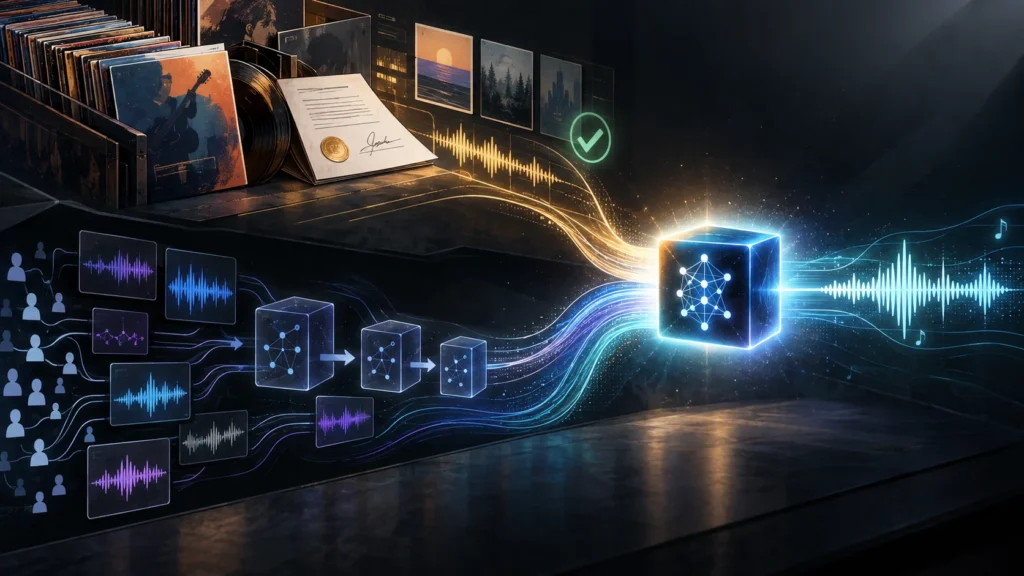
Their complaint alleges that Suno used interactions with its earlier models—including generated outputs and preference information about which outputs users selected—to help develop v6. It also alleges the use of knowledge-distillation techniques in which a newer “student” model learns behavior associated with an earlier “teacher” model.
The labels’ theory is that information derived from models allegedly trained on unauthorized copies cannot simply become legally clean because it passes through synthetic outputs, user-preference signals or another generation of model training.
They describe v6 as the “fruit of the same poisoned tree.”
That phrase is an allegation, not a judicial conclusion.
But the question behind it is significant.
Suppose a company trains Model A on disputed copyrighted material.
Then it trains Model B on outputs, evaluations or learned behavior originating with Model A, while directly supplying Model B with a newly licensed dataset.
Has Model B started over?
Or has some legally relevant value from the original material crossed the boundary?
The Suno case has not answered that.
It may become one of its most consequential questions.
A German court has already rejected Suno’s position on a narrower set of works
The U.S. cases remain unresolved on their central copyright question.
Suno has not had the same result everywhere.
On July 31, 2026, the Regional Court of Munich I largely ruled in favor of German collecting society GEMA in litigation involving six musical compositions. The court concluded, among other things, that the works were reproducibly memorized in certain Suno models and that outputs generated from relatively open-ended prompts reproduced protectable elements. It also concluded that the training reproductions at issue were not protected by fair use under the U.S. law it applied to those U.S.-based training acts.
That ruling is important.
It is also not final.
The Munich court expressly states that the judgment is not yet legally final, meaning appeal remains possible. And a German trial-court ruling does not decide Judge Saylor’s U.S. cases.
The cases involve different parties, works, evidentiary records and legal frameworks.
Treating the German judgment as though Suno has already lost the U.S. fair-use fight would overstate what it establishes.
Ignoring it would understate how seriously the copyright argument is now being tested.
What has actually been established
At this point, a few facts are difficult to dispute.
Suno trained its earlier systems on tens of millions of recordings gathered from publicly available sources, with copyrighted major-label recordings presumably included. Suno obtained YouTube audio for training and has admitted using YT-DLP. Universal and Sony originally sued over 560 works and have now filed a second action asserting 60,202 more. Warner settled and became a partner. BMG and Believe entered their own agreements. Suno launched v6 with those industry partners and retired its previous generation of models.
The unresolved questions are larger.
Was Suno’s copying for model training fair use?
Did the way it obtained YouTube files violate the DMCA?
What damages, if any, follow?
Do Suno’s licensing deals demonstrate a market that its earlier unlicensed activity harmed?
And does v6 stand independently from the models that preceded it, or can a later model inherit legally relevant material through generated data, preference signals or distillation?
The existing 2024 case is approaching another important procedural point: fact discovery is scheduled to close September 30, 2026, with dispositive motions currently due in April 2027. Judge Saylor has already said summary judgment on the fair-use defense will likely resolve the predominant issue in that case.
The new 60,202-work case has barely begun.
That leaves Suno in a peculiar position.
The company is no longer arguing from a world in which licensing AI training is merely hypothetical. It now has licensing partners. Its newest models are built around those relationships. Its older models are retired.
But the old models have not disappeared from the litigation.
Universal and Sony are asking a court to decide whether Suno was allowed to build them the way it did—and whether what those models learned can follow the company into the supposedly licensed era that came next.
That is the part I would watch.
Not the $9 billion number.
The boundary between the old model and the new one.
Because if that boundary does not hold legally, this case stops being only about how Suno built its first successful music models.
It becomes a case about whether an AI company can ever cleanly leave disputed training data behind.
Sources and verification notes
- UMG Recordings et al. v. Suno, Inc., No. 1:24-cv-11611-FDS — original June 24, 2024 complaint, Suno’s August 1, 2024 answer, August 18, 2026 orders on the DMCA amendment and 61,026-work amendment, and Suno’s September 1, 2026 amended answer.
- UMG Recordings et al. v. Suno, Inc., No. 1:26-cv-14275 — second case filed September 18, 2026; current docket confirms the filing, parties, judge and initial case activity.
- Warner Music Group / Suno partnership announcement, November 25, 2025 — confirms the partnership and settlement of prior litigation.
- BMG / Suno alliance, August 12, 2026 — confirms licensed collaboration and settlement of prior use of BMG works.
- Believe / TuneCore / Suno partnership, September 8, 2026 — confirms opt-in licensed participation in Suno’s new model program.
- Suno v6 announcement and current FAQ, September 9, 2026 — confirms industry-partner model launch and retirement of pre-v6 models.
- Regional Court of Munich I, GEMA v. Suno, July 31, 2026 — official court summary of the first-instance German judgment; the court states expressly that the judgment is not final.
Verification boundary: Allegations concerning infringement by the 60,202 recordings, the alleged legal “taint” of v6, knowledge distillation and market harm remain allegations made by Universal and Sony. Suno disputes those claims. The U.S. courts have not yet issued a merits ruling deciding whether Suno’s music-model training constitutes fair use.
