What Happens to Your Unreleased Files After You Upload Them to an AI Tool?
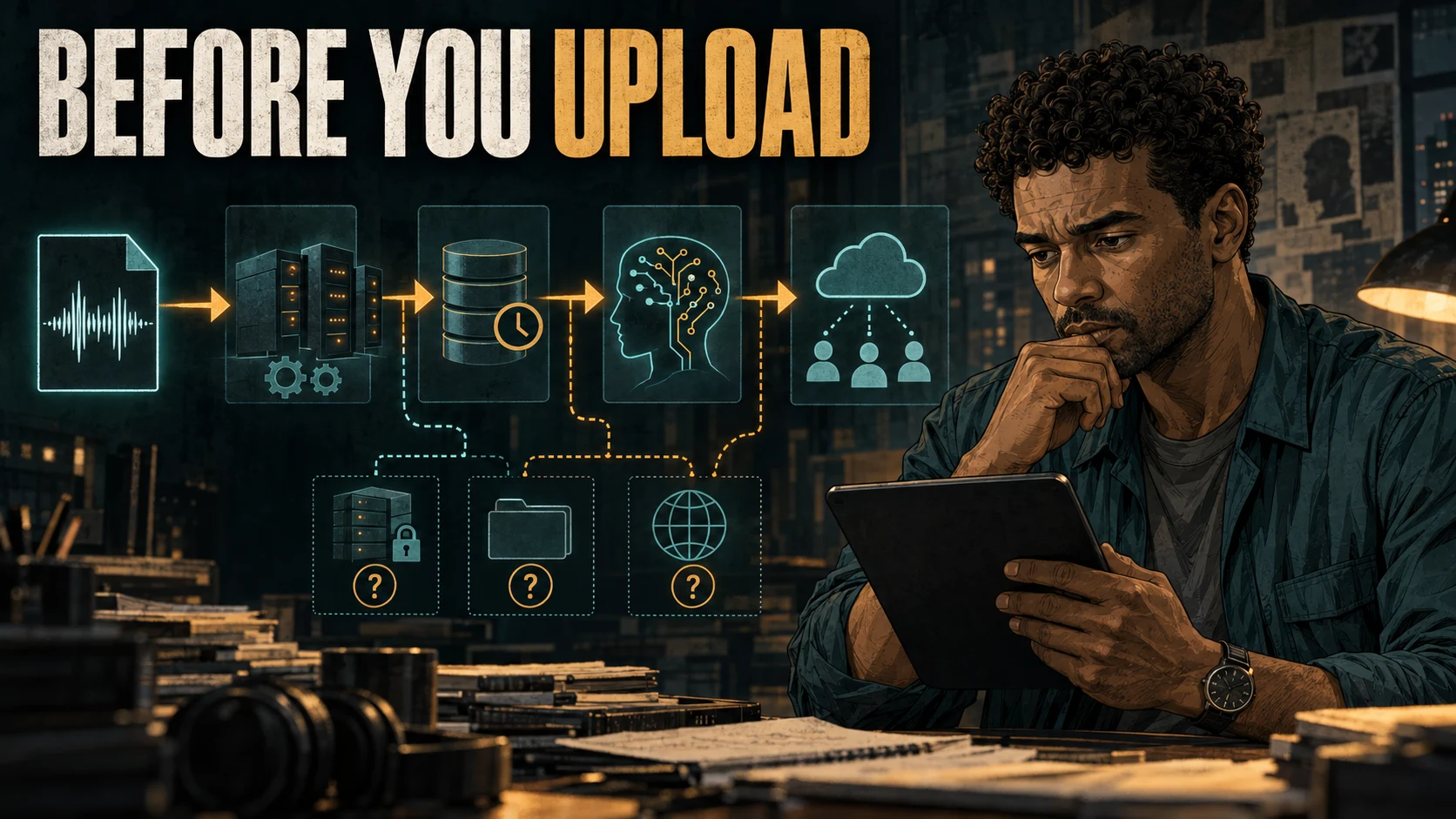
Uploading a file gives a service a copy to process. What happens after that depends on the service, the feature you use, your account terms, your settings, and the file’s purpose. Calling a project private does not answer every question about training, retention, or sharing.
The useful decision comes before the upload. Find out what permission you are granting, what protections the service documents, and what it leaves unanswered. Paying for an account does not replace that check.
This article reviews official policy statements checked October 12, 2026. ACLTracks did not audit a provider’s backend, upload confidential test files, or verify deletion from storage systems. A policy documents a stated rule. It is not direct evidence of every action taken during processing.
Ask five questions about the specific feature
What does the service need to do with your file to provide the feature? Can it use the content for model training or improvement? Who can access or receive it? How long can it be retained? And what does deletion remove, including any exceptions?
Ask those questions about the feature you plan to use. Reference-audio search, voice modeling, transcription, and generative remix may be covered by different provisions, even when they are offered under one account. A permission statement for one feature is not automatically a promise about the rest.
Keep content rights and privacy terms distinct. A song file may include creative material, a recognizable voice, filenames, and other information. The content license and privacy notice may address different aspects of the same upload.
Read the training language in context
Suno: Terms of Service grants a broad license for service provision and improvement, including related AI and machine-learning models. That is meaningful permission language. It does not prove that a specific unreleased file was used in a training run. It also should not be reduced to a narrow, temporary right to process an upload.
Splice: Uploaded reference audio and model training says that audio uploaded for Search with Sound is used to find compatible sounds, is not used to train AI models, and is not shared with other Splice users. Keep that statement attached to Search with Sound. It does not establish the terms for unrelated products or uploads.
Adobe: Firefly training approach says Adobe does not train Firefly on customer content and distinguishes that content from separately licensed Adobe Stock material. This addresses training. By itself, it does not answer every question about storage duration or what happens when you choose to publish content.
“AI tools use uploads” is too broad to be useful. The applicable permission depends on the feature and terms that govern your account. Check those terms rather than assuming a reassuring headline covers every operation.
Storage and training are separate questions
A service may retain a file to provide or operate a feature without using it to train a model. Logs and other information may also be retained separately from the visible project. Before assigning one retention period to an entire upload, check which data category each policy statement actually covers.
Suno: Privacy Notice describes retention for as long as reasonably necessary for listed purposes and says deletion requests are subject to exceptions. It does not set one universal deletion deadline for every uploaded creative file. Do not turn that wording into a promise that all copies disappear after a fixed number of days.
If the policy does not provide the detail your confidential project requires, mark it as unknown. A support response or enterprise agreement may clarify the terms for your use. Keep any answer with its date and scope so the next person handling the file knows what was actually confirmed.
Check sharing separately
Review the project’s visibility, link-sharing settings, community submission options, and remix controls. A project excluded from general browsing may still be reachable through a shared link. A collaborator’s copy creates another boundary, and your account’s delete function may not control it.
Before submitting an unreleased performance, check whether it includes someone else’s voice or creative work. Permission to mix a collaborator’s recording does not automatically include permission to create a voice model from it. Confirm the intended use and any limits before transferring the material.
If the service has a public gallery, treat submission as a separate decision. Do not assume a private creation stays private after you share it or submit it to a community feature. Record that choice with the project.
Limit what you send when you can
If a feature needs only a short excerpt, consider sending that instead of the complete unreleased master. Remove unrelated private information from filenames or notes. This limits the material transferred. It does not guarantee that the excerpt has no rights or privacy implications.
When evaluating a workflow, a synthetic or non-confidential example can help you decide whether the feature is useful before you submit a sensitive recording. Keep the test conditions clear. A successful test with that example does not verify how the provider will handle a later confidential source.
If a local-processing option is available, check that it actually processes the file locally. A desktop interface may still connect to a cloud service. Where the interface appears is not proof of where processing happens.
Decide from the documented boundary
Keep a short record of the feature, account type, purpose, source permissions, relevant policies, settings, open questions, and file version you supplied. Revisit it when the feature or policy changes. Using the same song for a different operation may require a new decision.
Avoid uploading confidential or restricted material until the documented conditions are acceptable for that project. You do not need proof that a provider mishandled a file to decide its terms are unsuitable. You need to understand the rights you grant, the handling the provider describes, and the uncertainty you are willing to accept.
Sources and scope
Official sources were checked October 12, 2026. Product and policy statements describe the cited documentation. ACLTracks did not conduct backend audits or deletion tests for this article.
**Editorial note:** I kept the distinctions between training, storage, access, and sharing explicit. The article describes what the cited policies say, not verified backend behavior.